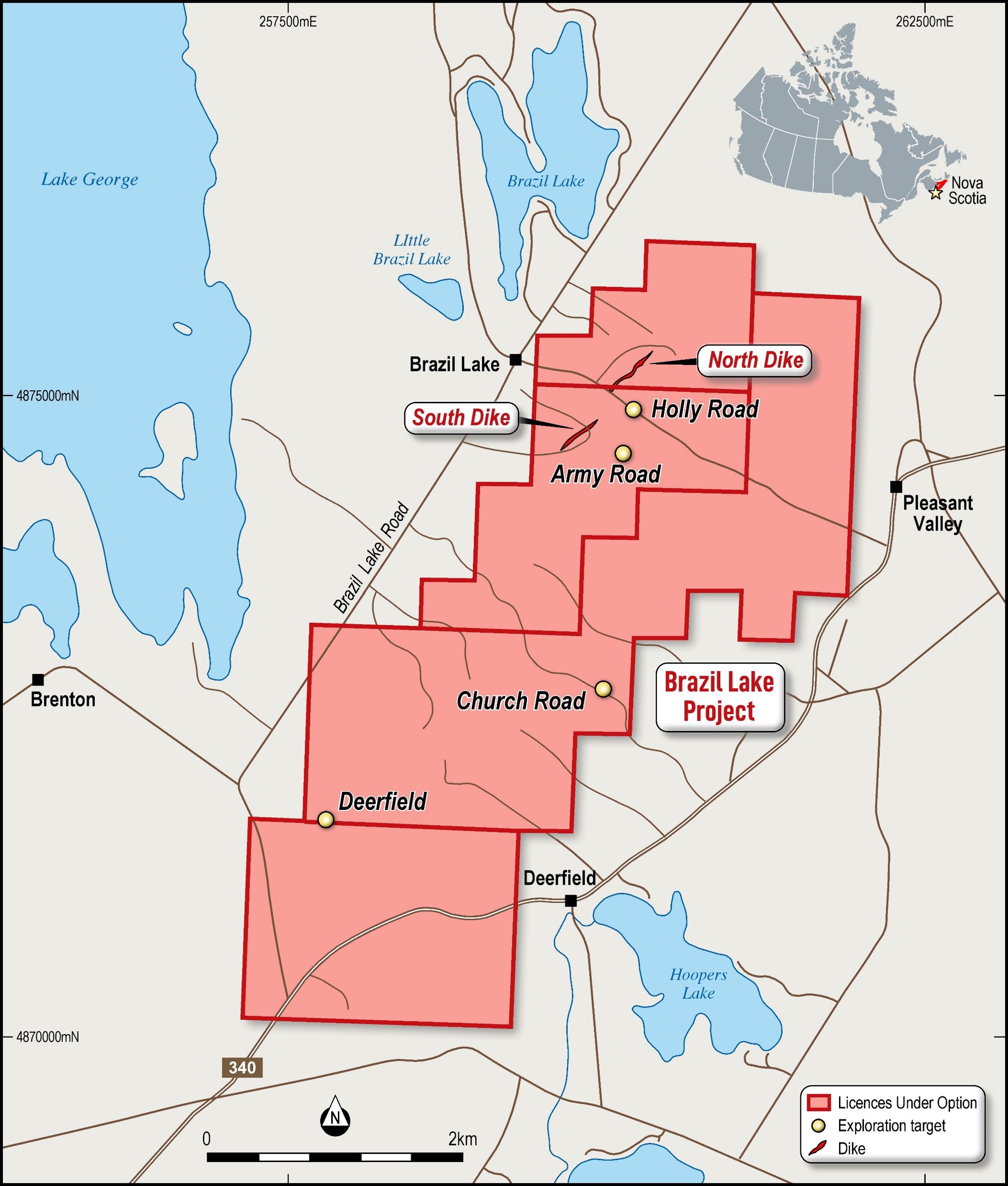

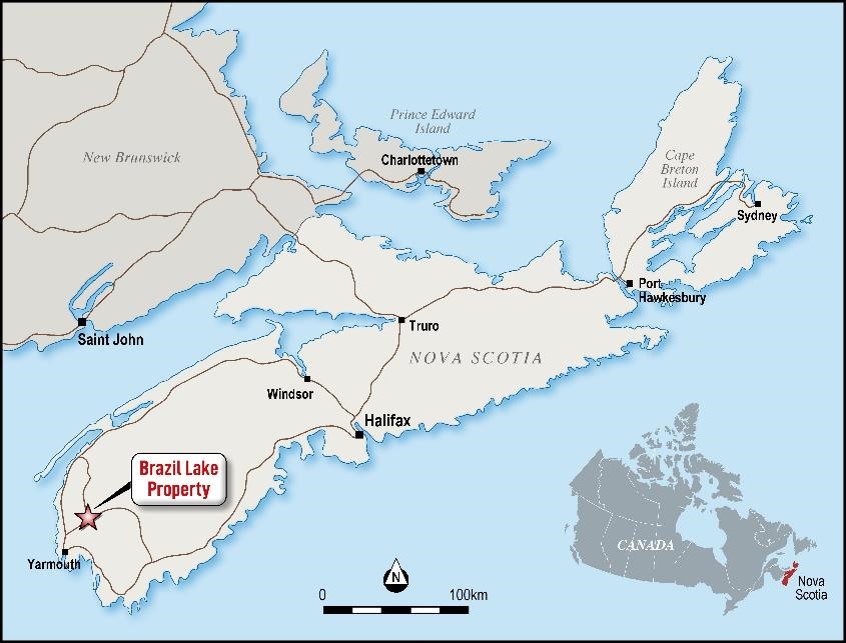
The Brazil Lake Lithium Project is located in southern Nova Scotia, Canada approximately 25 km northeast of Yarmouth and approximately 300 km southwest of the City of Halifax (Figure 1). The region can be accessed via highways 101 and 103 and the project area is easily accessible via Route 340 (bitumen road) and then along secondary gravel roads.
Geology and Mineralisation
The highly evolved, spodumene-bearing pegmatites within the Brazil Lake Lithium Project that are the focus of Lithium Springs Limited's exploration are hosted by meta-sedimentary and meta-volcanic rocks of the White Rock Formation, which locally include quartzite, amphibolite, tuff, psammite and pelitic schist. The White Rock Formation sequence strikes northeast / southwest and locally dips steeply to both northwest and southeast. These rocks are part of the southwestern part of the Meguma terrane of the Canadian Appalachian Orogen.
Exploration and Drilling
The most recent exploration and drilling on the Brazil Lake Lithium Project was completed by Lithium Springs Limited, in conjunction with our project partners Champlain Mineral Ventures Ltd. Prior to LS1's involvement in the project, all previous exploration of the Brazil Lake Lithium Project and the surrounding areas was completed by Champlain Mineral Ventures Ltd; other than some early-stage exploration completed by the Nova Scotia Department of Natural Resources and Renewables (NSDNRR) in 1960-1993, which included 5 drill holes for a total of 577m. Champlain completed 16 diamond drill holes for a total of 1,325m in 2002; 16 diamond drill holes for a total of 801m in 2003; 28 drill holes for a total of 2,666m in 2010; and 5 drill holes for a total of 505m in 2019; as well as field mapping and sampling (including pits), soils surveys, trenching and geophysics.
Champlain also completed a bulk mineralogical investigation of the North Pegmatite (from drill hole BZ-02-13), which revealed that locally the pegmatite was made up of 16.3% spodumene, 11% microcline (potassium feldspar), 33% cleavelandite (sodium feldspar), 6% muscovite, and 34% quartz by weight. This sample was then subjected to metallurgical testwork, which produced a spodumene concentrate with highly encouraging Li₂O grade and recoveries utilising heavy liquid separation. Lithium Springs is currently in the process of verifying the historical metallurgical testwork through independently verified testwork being completed by SGS Lakefield, Canada.